

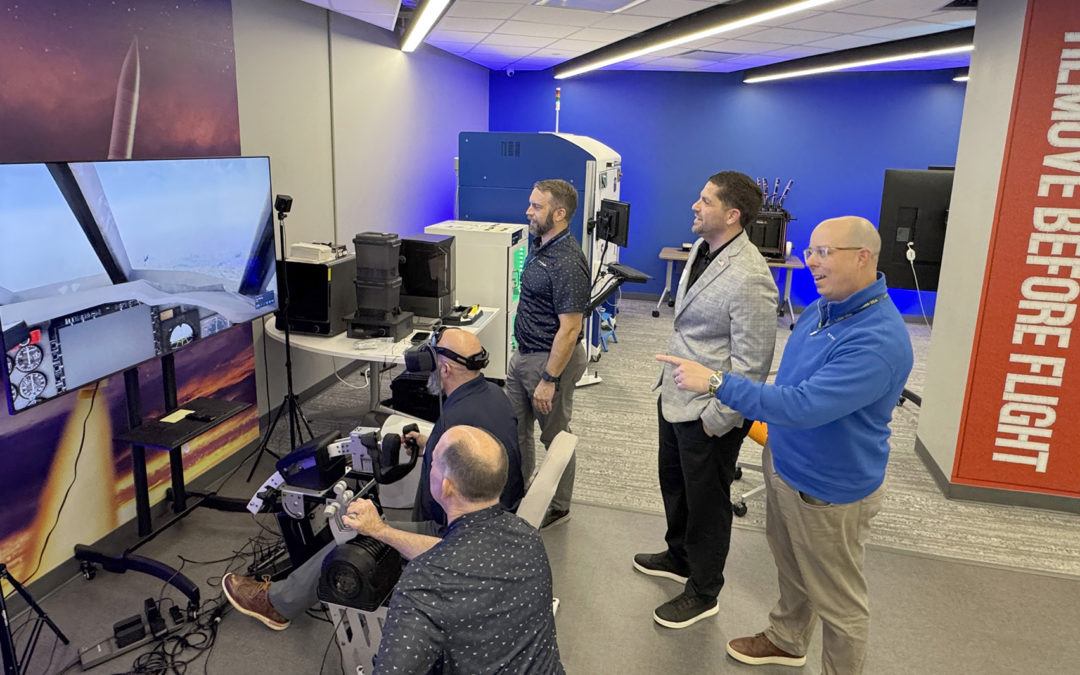
Visitors to the STRIKEWERX Innovation Lab in the Cyber Innovation Center Bossier City, La., test out the Experiential Air Refueling Lightweight simulator. This prototype that teaches air refueling was one of several delivered by STRIKEWERX to Air Force Global Strike Command in 2025. (U.S. Air Force courtesy photo by Sean Green, STRIKEWERX)
By Sean Green | Facilitation and Outreach Manager
BOSSIER CITY, La. — STRIKEWERX, the innovation hub for Air Force Global Strike Command (AFGSC), spent 2025 collaborating with companies to create new technologies that support the warfighter and now total more than $300 million in savings.
Housed at the Cyber Innovation Center (CIC) in Bossier City, Louisiana, STRIKEWERX has used its space and resources to connect government, industry, and academia to solve the command’s most difficult problems. Since 2017, STRIKEWERX has produced savings to the Air Force worth $302.6 million.
“This dynamic partnership delivered measurable progress in accelerating solutions to warfighter challenges, bridging the gap between cutting-edge commercial technology and operational need in fiscal year 2025,” said Kevin Nolten, CIC president. “From fostering deeper engagement with non-traditional partners, to rapidly prototyping game-changing capabilities, STRIKEWERX proved to be a catalyst for transformation across AFGSC.”
In FY2025, STRIKEWERX had 76 active contracts worth $9.4 million. Thirteen of the active contracts were with northwest Louisiana area businesses for a total value of $1.4 million. STRIKEWERX also supported 23 Air Force events with 1,146 attendees, generating an estimated economic impact of more than $720,000.
“The past year was strong and productive for STRIKEWERX, marked by continued innovation and impact across its innovation portfolio with the delivery of 18 projects and adding 15 new ones,” said Russ Mathers, director of STRIKEWERX. “The year’s successes stand as a testament to the power of public-private collaboration in driving strategic advantage for our nation’s defense.”
Notable projects include:
- B-52 engine covers — STRIKEWERX worked with Transhield to produce a new prototype that would protect the engines of the B-52 Stratofortress from ice buildup in cold weather environments. Operational Energy Savings Account (OESA) funds were used to equip the entire wing at Minot Air Force Base, North Dakota, potentially saving $5.67 million per year in damages.
- Experiential Air Refueling Lightweight simulator (EARL) — STRIKEWERX supported Specular Theory’s development of a hardware and software prototype designed to train B-52 student pilots in air refueling. As the only ground-based capability for air refueling practice in the B-52 community, EARL is expected to save approximately $10 million in flying-hour costs per training class, with two to three classes per year.
- Stationary and Mobile UAS Reveal and Intercept (SAMURAI) — STRIKEWERX provided market research to test the feasibility of defending AFGSC convoys from swarming, autonomous small, unmanned aircraft systems (sUAS) on the move through a prototype that integrates sensing, electronic warfare, and drone-on-drone technology. This project proved that a layered, mobile sUAS defense prototype can be integrated into a single system while pushing research and development of counter sUAS.
- Nuclear Command, Control, and Communications (NC3) command post trainer — King Crow Studios worked with STRIKEWERX to develop a virtual reality (VR) training solution for NC3 Airmen to simulate set up of transportable communications systems in realistic, immersive environments. The trainer will allow more frequent and diverse training to improve agility for the command.
- Advanced Extremely High Frequency (AEHF) antenna shelter — Celina Tent built upon a STRIKEWERX design sprint to produce a rapidly-inflatable, tent-like shelter that will protect maintainers from extreme cold and heat while working on the Intercontinental Ballistic Missile (ICBM) AEHF antenna. The shelters are expected to drastically reduce maintenance time and duration, protect maintainers from environmental hazards, and reduce weather-related damage to AEHF antennas.
- Senior design projects — Higher education students in engineering programs gained real world experience developing seven new project designs for multiple aircraft support tools and systems, including the conversion of a fuel tank for storage on the B-1 Lancer, a drag chute packing fixture on the B-52, and a cradle to help support the tasks of E-4B Nightwatch maintainers. In 2025, new institutions participated in the program with two prototypes being tested immediately and one more being selected for further refinement.
Dr. Paul Hausgen, acting chief scientist for AFGSC, noted STRIKEWERX’s growing role as a trusted innovation partner delivering mission-focused solutions for the command and beyond.
“STRIKEWERX delivered on their promise of innovation, collaboration, and realization in 2025 and we are thrilled to continue our partnership,” said Hausgen. “We look forward to 2026 and increasing our combined impact on the command and Air Force at large.”